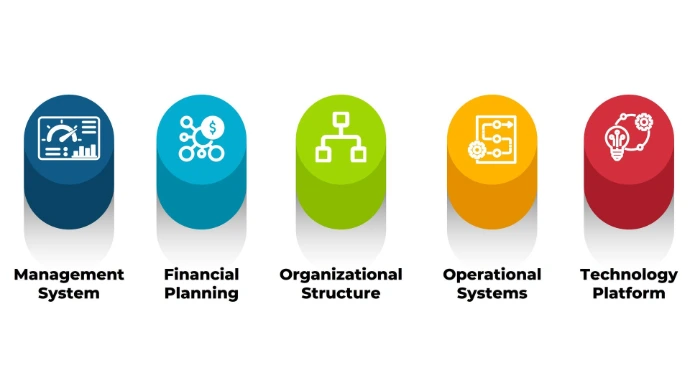
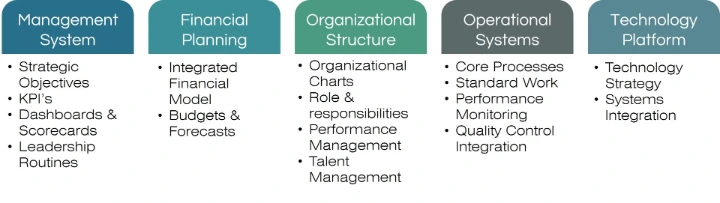
Management System: The Strategic Pulse
The first pillar focuses on establishing strategic control. A high-performance business requires clear leadership routines and data-driven dashboards that allow for a "single source of truth".
Key Focus:
- Defining KPIs
- Implementing management routines
- Using data to monitor deviations before they become crises.
Financial Planning: Discipline as a Foundation
Sustainable performance is impossible without integrating financial discipline into every operational decision. This pillar ensures that profitability is predictable rather than accidental.
Key Focus:
- Aligning financial health with long-term value creation
- Ensuring the business model is resilient enough to handle market shifts.
Organizational Structure: Accountability by Design
A business is only as strong as the people who run it, but even the best talent fails in a broken structure. PRAXMA emphasizes designing a team with clear roles, responsibilities, and accountability.
Moving away from micromanagement is possible by empowering teams with clear autonomy and ownership of their specific functions.
Key Focus:
- Roles & Responsibilities
- Performance Management
- Talent Management
Operational Systems: The Blueprint for Execution
Standardizing core processes—from sales to service delivery—guarantees consistent quality regardless of who is performing the task. This pillar turns "how we do things" into a repeatable asset.
Key Focus:
- Documenting SOPs
- Eliminating non-value-added tasks
- Ensuring that every promise made to a customer is fulfilled reliably.
Technology Platform: Efficiency Through Automation
The final pillar leverages technology to embed best practices and reduce human error. By automating key workflows, organizations can drive efficiency and scale without simply duplicating manual effort.
Key Focus:
- Reconfiguring technology to support processes rather than the other way around.
- Use automation to free up human talent for higher-value work.